Showing posts with label book review. Show all posts

February 18, 2013

Modern Quilts with Roots

In the six months I've been quilting, I've exposed myself to a lot of blogs, books, magazines, and exhibits on quilting and the history behind it.  All needle- and fiber-arts have deep roots, usually related to necessity rather than the art and craft we associate with it in 2013.  While I'm drawn to modern quilts and fabrics, it's not a surprise that these themes aren't original and can be seen in works from two centuries ago. 

My mom gave me this book in May, before I started quilting, and I skimmed it but didn't really pay much attention until this weekend.  This isn't a book review, but I wanted to talk about the main theme I saw in this book, from 2004: quilts from 1850 are more relevant than quilts from 1950.


A lot of these quilt styles are easily recognizable: sawtooth stars, lone stars, pinwheels, nine patches, on and on.  I've ever reviewed them here, in my Modern Quilts, Traditional Inspiration and Liberty Love reviews.  They can be seen on Etsy, on Flickr, on blogs--made with Momo and Anna Maria Horner instead of men's uniforms or old dresses.  Upcycling is still relevant--Ariel is the best example of this I know!--but it isn't the only option anymore. The fabric retail industry shows just how much freedom there is in fabric styles, colors, and themes, and choosing to add new into the old is a very modern choice.


This quilt in particular reminds me of Farmer's Wife quilt blocks.  I've seen them done in everything from batiks to Echino.


"Crazy Quilt"--the first improv quilt?

Stripes.  Solids.  Saturated colors.  This quilt isn't featured on the MQG blog--it's 100 years old.
However, for as many relevant quilts there were in this book, there were also quite a few that made me cringe.  While it's true that this book is almost ten years old, the quilts featured date back for hundreds of years.  It surprises me that so many antique styles can look contemporary, but all it takes is a bad applique or a weird scalloped edge to date it immediately.

These were some examples of quilt styles not typically celebrated by modern quilters.  "Whig's Defeat," from the late 1800s, features a scalloped edge and fabrics in cream, mauve, and hunter green.  The funny thing is, instead of the 1880s, it looks like the 1980s.  While these styles certainly have their place in history, it's completely offbase with the modern/traditional movement.


However, ironically, the worst section in the book was the "modern" section: 1950 - present.  2004 was before Modern Quilt Guild, before Heather Ross and Amy Butler, before the resources we have today.  Looking at the quilts labeled contemporary in this books makes me realize just how far modern quilting has come in the past few years.  That's not to say there aren't plenty of quilters still using these techniques; one visit to a traditional quilt shop shows that batiks are alive and well!  But for as much as I loved the Civil War sawtooth, pinwheel, and lonestar styles, I couldn't imagine ever using a template to cut out and applique a polar bear to a bear claw quilt.  Jeni B. has a bear claw quilt in Modern Quilts From the Blogging Universe that is wholly new and fresh while not reinventing the wheel.

Polar bear applique.  Need I say more?


I think what this book says to me most is that color choice really matters and has changed quite a bit.  The 1800s had muted calicos and stripes--women and men wore these homespun fabrics so they were naturally used in home projects.  As quilting became more decorative than functional, and fabric choices evolved from clothing scraps to a growing stash, quilts lost their traditional edge: featuring goldfish instead of stars, and flowers instead of nine patches.  Modern quilting has gone back to these roots, keeping a foot in both worlds: functional quilts made with designer fabrics.  They aren't thumbing their nose at tradition, but rather paying an homage.  

There is a well-known animosity between modern and traditional quilters, and whether or not you've experienced it, you probably know the main disagreements: modern quilters don't have enough rules and traditional quilters are too stuffy; modern quilters need a color wheel lesson and traditional quilters need to brighten up and add prints.  I think this book in particular is deep-rooted in tradition and traditional quilting; if it were written in 2008 or 2009, improv quilts would be in the contemporary section without a doubt.  I find myself gravitating to the older quilts in all traditional books--art quilts are normally featured as "contemporary" and, seeing as how they're almost wholly non-functional, they just go against what I think a quilt should be: a blanket.  

It's important to know the history of what you're doing, whether it's painting, quilting, or making dinner.  Nothing exists in a vacuum.  Pulling from the past and deciding how those traditions are interpreted helps to further a movement.  Books like this one are a great resource because they explain the background of how our favorite blocks came to be.  But it definitely takes an editing eye to decide what is relevant and what isn't, what is true to one's style and what isn't.  As with any book, every project isn't doable, but once a quilter is able to determine what is and isn't his or her style, choosing quilt blocks and merging them with a stash--upcycled or new--becomes easier and more meaningful once it becomes deliberate.

How do you merge old and new in your own work?  Do you know what your style is or are you dabbling?

February 4, 2013

Book Review: Liberty Love

I've gone a little crazy these last few weeks--I think upwards of five quilting/sewing books have been delivered to my house since January 1.  What can I say?  My Amazon wishlist has been lonely and I needed to spend some time with it.  And this doesn't include the number of books coming from the library!

I plan on reviewing most (if not all, let's see how boring my upcoming projects are!) of these books, and wanted to start with the latest release: Liberty Love, by Alexia Abegg.


I also thought this would be a great opener because it ties the two of us--Ariel, Ms. Londoner, and me, country bumpkin U.S.A.--together, even though Ariel has told me she doesn't go to Liberty.  I admire her restraint.  I'm a bit of a ridiculous person (see above re: books) and would blow my entire salary there in a couple weeks.

I have really high standards for books, both fiction and non-fiction, and craft books are no different.  I won't accept a book with an excess of unnecessary projects, especially projects that seem to exist only to waste my stash. I also don't want anything too cute, too country, too babyish, or too outlandish.  Thankfully, this book arrived and I didn't have any of those thoughts at all.


The book opens with this picture, the Marcelle Medallion quilt.  I love this as more of a work of art than a quilt.  Look at all the different fabrics used!  I see Liberty, Denyse Schmidt, MoMo, Yuwa, Pez...such an eclectic mix.  It boggles my mind that someone (Alexia Abegg, I'd bet) chose the fabrics, put them together, and walked away with a quilt so gorgeous it looks like both 2013 and 1913, even 1863.  I love it!

After the introduction and the obligatory "here's how to sew" section, Abegg includes a fold-out of Classic and Seasonal Liberty prints:


 I want them all.

The projects included in the book are sectioned by type: baby quilts, quilts, accessories, clothing, what have you.  I love the baby quilts.  I really enjoy making baby quilts anyway, but the Liberty and modern fabrics together are so feminine and soft I want to make them for myself and my cats.


Who doesn't love stars?  This is the Sugar Stars Quilt.

I almost never sew accessories, and I don't know why, because they're such a good use of small scraps.  However, I've been thinking of a new pincushion lately, because my little tomato is falling apart at the seams, and this log cabin pincushion is just too pretty.  It would also be pretty cost-efficient: there are plenty of Etsy listings for Liberty scraps under $15, and considering how tiny these pieces are, you'd be able to make a few pincushions from one scrap pack.


I also like the Sew and Go Organizer, which is surprising, because these typically don't hold my interest.  I don't travel with my sewing, but I'm attending the Sew South Retreat next month and will need to pack up my things and trek off to the South Park neighborhood of Charlotte.  This would keep everything together, but I think I need some Liberty-themed scissors, definitely.


 The clothing in this book also stands out as "adorable" instead of "an afterthought."  Seriously, if I never see another boxy, caftan-like pattern in a book, it will be too soon.  Alexia designs for Green Bee Patterns and many of her patterns are for women and children.  Unsurprisingly, those were the patterns I liked the most!

The Little Pearl dress is so classic and feminine, lacking ruffles, hot pink, or an excess of quilting cottons.  I need to make an army of these for absolutely no reason at all.


The Michelle My Belle dress is also so summery, and is the big-girl version of Little Pearl.  Instead of Liberty, though that is wonderful, I'd like to make one in chambray with a tiny Liberty ruffle for the spring.  I did just get a nice cut of chambray I've been itching to use...


The Lulu Tunic reminds me of Colette's Macaron but not as dressy.  This would be cute with leggings in the fall or winter.


One giant perk is all the patterns are included in the back of the book!  I'm not picky about pattern envelopes; I see some bad reviews on Amazon for different books because "the envelope doesn't have a Velcro closing--how am I supposed to keep track of paper in an envelope?!"  Well, be an adult and just do it.  Anyway, I really appreciate books that include patterns instead of basing everything on templates or rectangles.  Thanks Alexia!


Overall, I give this book two thumbs up and think it's a great addition to any modern sewing library.  Now I need to go buy a ton of Liberty and never escape the crushing debt it causes, at $37.00 a yard.

I was not compensated for this review.  I bought my copy off Amazon.  I really love books and sewing and am more than happy to spend money and share my opinions with the masses.

August 20, 2012

Book Review: Denyse Schmidt, Modern Quilts, Traditional Inspiration

I don't have a whole lot of progress to update on, so I thought, for a change of pace, I'd post a book review!

I love Denyse Schmidt and have for many years.  I'm attending her lecture next month in Manhattan and buy her lines as soon as they're released.  Recently, I also picked up her newest book, Modern Quilts, Traditional Inspiration.  This book contains patterns and instructions as well as background on these pieces.  While they're technically traditional styles, Denyse (we're on a first-name basis) has used modern colors and techniques to make them wholly new.

Let's take a look!  But first: I apologize for the photo quality.  Rainy days kill any sort of natural lighting.


The orange peel quilt is featured early in her book.  Using crimson and tangerine, two colors not normally seen together, this quilt has a lot of movement and warmth, seen on the pattern page:


I don't think I'm anywhere near being ready to make an orange peel quilt, but maybe by this time next year I'll be able to.


I love, love, love star quilts.  A red-and-white star quilt is my absolute favorite.  So this Crazy Star, with a mish-mash of coordinating fabrics on a solid background, really speaks to me.  


There are so many possibilities!  I'd love various reds on a light blue background.


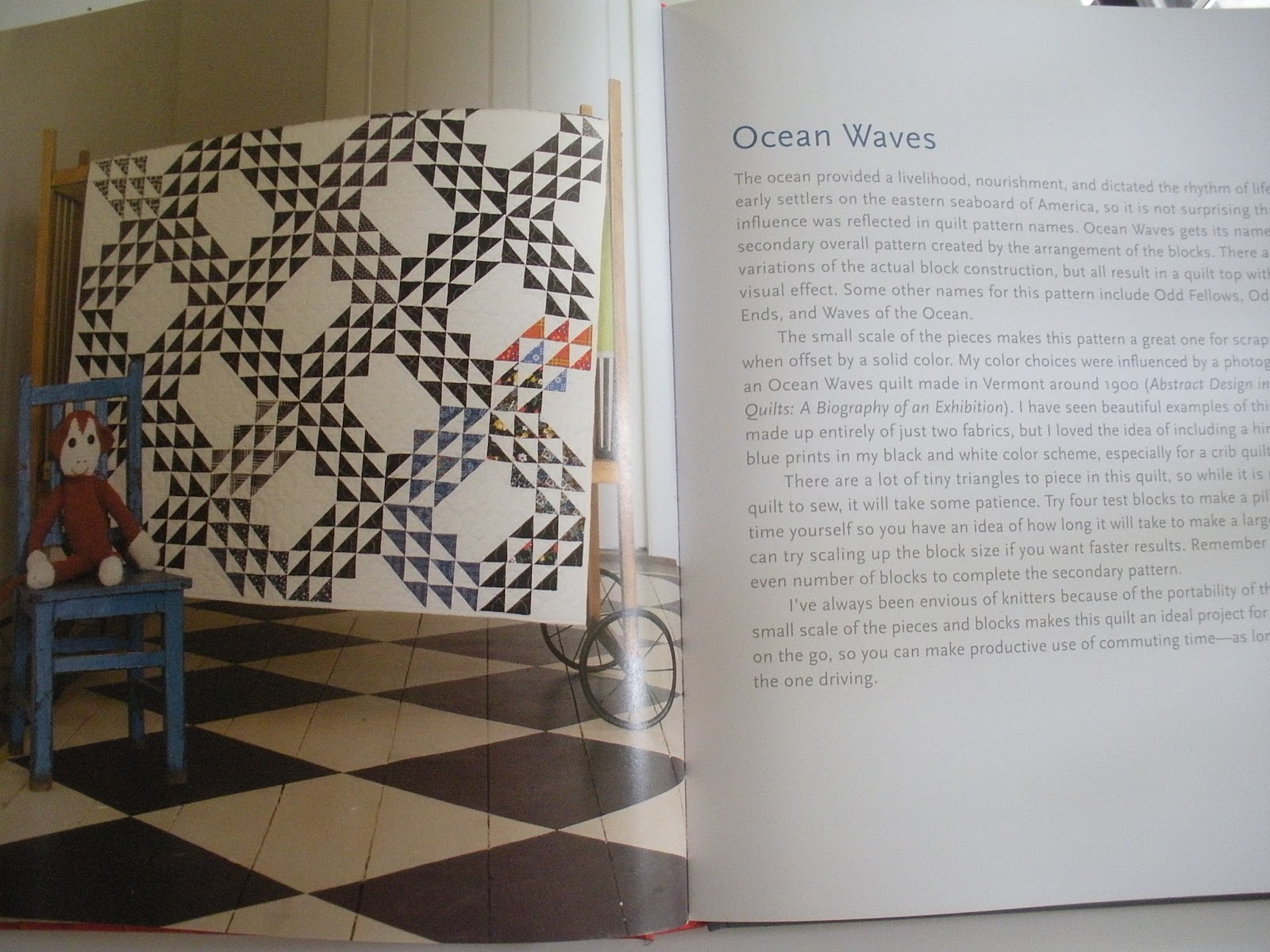
Flying Geese, which are another favorite of mine, have a different layout in Ocean Waves.  I bought Denyse's pattern "Point Me," which also features geese, in the spring, and love the new ways she arranges them.


Imagine the possibilities with Courthouse Steps!  Denyse uses three colors here, but two colors, a color and a pattern, or scraps would all create different effects.


Wagon Wheel is, hands down, my favorite quilt in this book.  I love the chartreuse!  Again, curves are probably beyond my capabilities right now, but soon enough...


This Snake quilt reminds me of Denyse's "Single Girl," deconstructed.  The colors are similar, the curves are present, but instead of single rings, there's a steady movement from corner to corner.


There's a Mariner's Compass quilt hanging in the store where my Modern Quilt Guild meetings are held, and it's always used as the prime example of what modern quilts aren't: the precision, the batiks, the size are all too rigid and old-fashioned for most modern quilters.  But My Compass, Denyse's version of a Mariner's Compass, is breathtaking and modern in a primitive way.  

A lot of these quilts remind me of Civil War-era or Amish quilts: the roots of quilting are present, but solids and scraps are used to create a unique version.  Simply put, I believe Denyse Schmidt is a genius and her interpretations of these traditional values add depth to the modern quilt world, especially when many quilters believe we just do improv blocks and only use white.  This book is chock full of inspiration and gorgeous photos.  Take a look through it yourself!

For 2012, on my blog Lemony Fresh, I made a resolution to create over thirty apparel items throughout the year.  Next year I might shift my focus to quilting, and quilt my way through this book, not necessarily in order.  Kind of a Julie & Julia (looking at you, Ariel!), but I imagine my version of Julie's eggs will be applique.  What do you think?

What have you used as inspiration lately?  Are there any books you'd recommend?